Alumni
One in 7,641: The story behind the Netflix Documentary
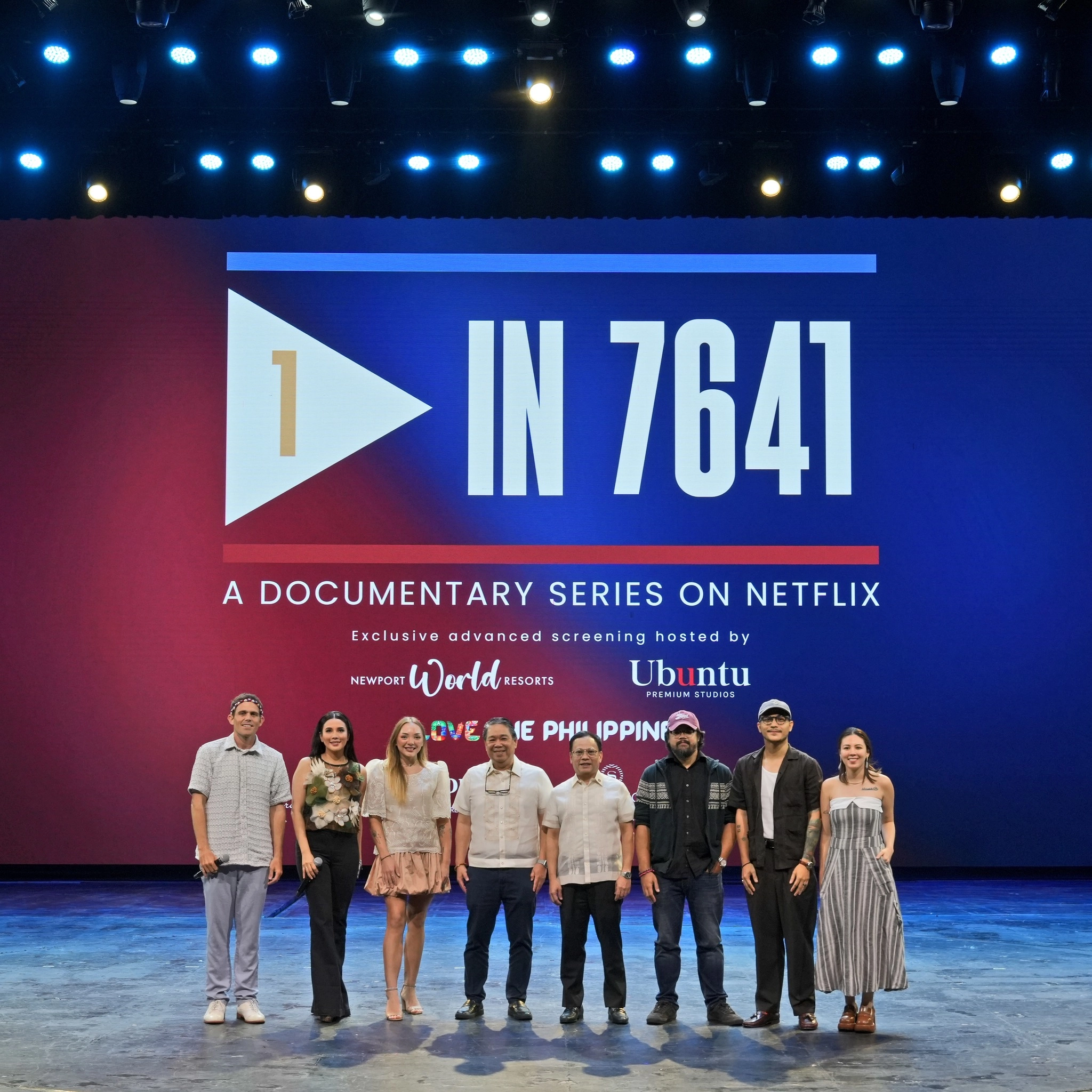
By the time 1 in 7641 landed on Netflix, it already felt like more than a tourism project. It was not selling the Philippines through postcard shots. It was trying to explain the country—why it looks the way it does, why it moves the way it moves, and why it keeps tugging at Filipinos no matter how far they’ve gone.
“We always wanted it on Netflix,” says Mike Sandejas ’91, who co-founded Ubuntu Premium Studios with Pok Estrella ’85. “Putting it on Netflix was something we aspired for and was made possible by our connections to some local Netflix executives. We closely coordinated with them to ensure that the Netflix standards and expectations were met.”
The company name isn’t just branding. Ubuntu is a Southern African concept often translated as “I am because we are,” a reminder that people become themselves through other people. Ubuntu Premium Studios leans into that meaning—defining ubuntu as “compassion and humanity” and positioning itself, in its own words, as “Content for Good.”
The project began as a Tourism Promotions Board brief and later moved under the Department of Tourism. The target audience was direct: Filipinos living abroad.
“The brief’s targeted audience was primarily Filipinos living in foreign countries—to go back home and reconnect with their roots,” Sandejas says. “I drew inspiration from Filipino-American youth who had a hunger to define their Filipino identity. I understood how confusing it could be for them.”
He frames it as an identity problem, not a travel problem.
“African Americans can draw so much from African culture. Mexican Americans would do the same with Mexican culture,” he says. “Filipino Americans looking towards home would see a lot of both Hispanic and American culture in their homeland. My initial goal was to explain why that is, and that it creates a unique culture that is a mixture of indigenous culture and cultures that influenced us during our colonial period.”
Even the title became part of the argument. The show was originally pitched as 1 in 7000, a cleaner number with a marketing-friendly acronym. It didn’t stay that way.
“The title was originally 1 in 7000, but the DOT wanted to be more accurate,” Sandejas says. “Thus, the exact number 7641 was used.”
That insistence on accuracy pointed to something bigger: the series wasn’t meant to be branding first and story second. It was meant to hold together as a cultural documentary.
“I drew up a format that made sure it would not be the predictable travel show format,” Sandejas says. “The show is a cultural documentary divided into themes and not your usual per-region format. This would allow us to feature more places in every thematic episode.”
To make the themes land, especially for viewers raised abroad, Sandejas added another device: a “guest” whose voice would be integral to the episode.
“To add a more unique perspective, I thought of having a guest in each episode that would be integral to each theme, giving a unique point of view of the experience,” he says. “In the episode about food, we invited Danielle Comerford. I believed that these guests provided the voice that the target audience would listen to.”
For Jag Concepcion 2013, who directed the surfing episode and served as co–director of photography across the series, the food episode became the one that stuck, partly because of what it captured, and partly because of what it did to the crew.
“My favorite one, besides my own, was the food episode,” Concepcion says. “Food and overall board culture mean a lot to me, and I think food is the love language of the Philippines.”
He remembers it as a stretch of hard travel and easy connection, what production life looks like when people start operating like family.
“Being able to travel around the Philippines eating good food, what’s not to love?” he says. “The crew got very close over these shoots. The food episode was a fun one because the crew got tattoos after the shoot, along with our host Dani.”
Concepcion describes the schedule as relentless, but the downtime as the glue.
“We essentially lived on set, going for days to weeks at a time to locations around the Philippines,” he says. “The schedules were packed during the days, but all the downtime and nights would always be filled by ‘one or two’ or even just a small fellowship over food.”
He even marks time by birthdays.
“I celebrated my birthday twice on set,” he says. “Pok and Mike made sure to do small celebrations.”
That mix, pressure during the day, bonding at night, carried a familiar rhythm for the Upsilonians on the team. The fraternity isn’t the subject of the show, but it runs through the way the production was executed: the pace, the expectations, the refusal to stall when things got messy.
“As a brod, I took a lot of things into this work,” Concepcion says. “I like to think I take my grit and ‘whatever it takes’ mentality into my work, pushing things to their limits.”
He describes the practical discipline behind the slogans.
“To do the work and trust the process. To not be the weak link in a team and just use everyone’s collective effort and strength to finish big tasks,” he says. “We always hear that in the frat, ‘when in doubt, all out; pain is temporary, glory is forever.’ I never really thought much of them during college. Working in film and media. I ended up living these things out throughout my entire post-graduate life.”
Sandejas credits Estrella for carrying the operational weight of the series, particularly because Sandejas was also shooting his feature film Sinagtala during much of principal photography.
“Pok was executive producer of the show and painstakingly designed the logistics while dealing directly with the DOT executives,” Sandejas says. “This project pretty much took over most of Pok’s life in 2024.”
He is blunt about what is required.
“The process took more than a year,” Sandejas says, “because of the processes needed to acquire the project; the time to do research and writing; preproduction; principal photography; and postproduction for all six episodes. Scheduling alone was a complex task.”
There were also constant production obstacles, the kind that don’t show up on screen but decide whether a show finishes strong or collapses under its own ambition.
“There were a lot of obstacles encountered during the production,” Sandejas says. “Upsilon training on the values of foresight and resourcefulness was very much relied upon. Quick decision-making skills came in handy.”
Even the host came through a mix of timing and instinct. They didn’t plan on having one, until Sandejas met Kyle “Kulas” Jennermann, the Canadian creator who had already spent years traveling the Philippines and building credibility as someone who genuinely tried to understand the country.
“Originally, we had not planned on having a host,” Sandejas says. “But then by chance I met Kyle ‘Kulas’ Jennermann. I merely mentioned this to Pok in passing, but Pok latched onto it and went on to convince Kulas to join us.”
As production moved across the country, the brotherhood showed up in practical ways, including support, access to locations, local coordination, and post-work. Sandejas credits Jag Concepcion and Benj Olfindo; he also notes the help they received from brods in different areas as the crew moved.
For Concepcion, the experience also reinforced a core truth about the culture around the work: excellence isn’t the whole point, people are.
“We work hard and play harder,” he says. “We do strive for excellence and the work that is required for it. But the same side of that coin is brotherhood, the ability to celebrate. and celebrate the fellowship that comes with the territory.”
In the end, Sandejas says they were conscious of the Netflix landscape. There were already similarly themed shows. They knew they had to stand out without chasing the same formula.
“Given that there were similarly themed shows on Netflix, originality made us stand out,” he says. “We delivered what was expected.”
But he insists the project was never just content.
“The project was rooted in our love for country,” Sandejas says. “Though it was tourism promotion, it was to us, a love letter to all the Filipinos around the world, asking them to visit home.”
And he makes a claim the team wears with pride, one that also explains why the show keeps being talked about as more than a series.
“As of January 2026, this is now the most aired Filipino-produced show abroad,” Sandejas says. “A second season is underway.”
If season one did what they hoped, it wasn’t because the beaches looked good. It’s because the show treated culture as the main event, something you return to, not something you consume.
“We hope we strengthened their Filipino identities,” Sandejas adds, “especially for their children who were born abroad and have never been back home.”
One country. 7,641 islands. And a production that ran on the same fuel the story was asking for: connection, pride, and the decision to come home, even if it’s only through a screen at first.
About the Author

Nuel Liamzon-Sanchez
Nuel Liamzon Sanchez 2023 earned his bachelor’s degree in Interdisciplinary Studies, with a minor in Economics, from the Ateneo de Manila University. As an undergraduate, he was a member of the UAAP Judo Team, led organizations such as the Google Developer Student Club Loyola and RC Life Loyola, and worked part-time at Country Builders Bank (now Top Bank) as a loans associate. In 2022, he served as a researcher at the UP School of Engineering and co-authored a paper on circular economy and urban mining, which was published in academic forums and presented to UNIDO in Italy. After graduating, he joined Willie Fernandez ’69 at Concept and Information Group Inc., managing national-scale media operations for the 2024 midterm elections. He also led fundraisers for the resident body, including the Resident’s Cup, and served as overall Upsilon Month Head in 2024. Nuel, a nephew of Herman Liamzon Sanchez ’85, is currently applying to law schools and hopes to become an attorney.