Alumni
The Hobo Tradition
Foreword
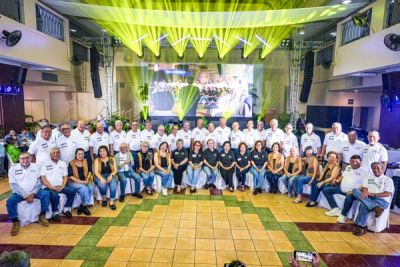
On the evening of December 8, 2025, alumni and resident members of the Upsilon Sigma Phi and the Sigma Delta Phi will troop to the Ang Bahay ng Alumni in the Diliman, Quezon City campus of the University of the Philippines (UP) to participate in a hobo, a traditional joint activity of the fraternity and the sorority held every so often at various venues.
In every hobo, designated groups of Upsilonians and Sigma Deltans compete with each other in a series of short contests involving singing, dancing, acting, and parlor games. Although each competition is a tough match involving skills, creativity, and wits, everything is done in the spirit of wholesome fun and amusement.
There are always two masters of ceremonies -- an Upsilonian and a Sigma Deltans. A small band of musicians or recorded music provides accompaniment for the performances. Of course, sumptuous food and premium drinks are a plenty during the hobo.
Even if the outstanding or impressive performances are obvious to the audience, and the Sigma Deltans are often the show stoppers, no winners are actually announced at the end of the event. In some instances, token gifts are handed over to the performers.
Toward the end of the hobo, there is a final number featuring an Upsilonian and a Sigma Deltan performing together on stage, to put a “reconciliatory” closure to the event.
At the conclusion of the event, the lingering brods and sisters engage in some nostalgic banter over the remaining booze and snacks, before calling it a night.
A Penchant for Dances
At the peak of the American colonial period in the Philippine Islands, many Filipinos in Manila became very fond of social dances, much as the Americans in the city were.
During the pre-war decades, cabarets1 in Manila were respectable places where many socialites, as well as rich and important peopl,e held court and danced their evenings away.2
The biggest of the big-time personalities of the period patronized the world-famous Santa Ana Cabaret in the nearby district of Santa Ana in Manila. Manuel Quezon, the President of the Commonwealth of the Philippines, and General Douglas MacArthur, the military advisor of the government, frequented the place. It was even featured on Life magazine.3
Evenings, especially Fridays and Saturdays after dark, were busy times in the Santa Ana Cabaret. During the early afternoons, college students in Manila, young Upsilonians included, went to the cabaret to learn how to dance in preparation for ballroom events, e.g., graduation balls and social dances. Taxi dancers were there to teach them.4
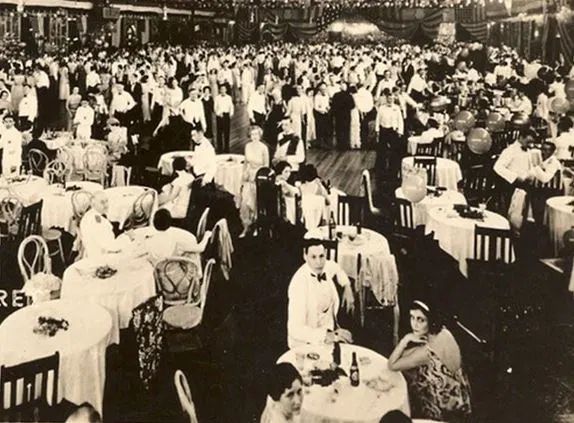
The Santa Ana Cabaret
Monthly Socials at UP Manila
The hobo tradition is unique to the Upsilon Sigma Phi and the Sigma Delta Phi. Other UP organizations, past and present, apparently do not have any such institutionalized activity.
This tradition in the fraternity and the sorority traces its origins to the old UP campus in the quaint Padre Faura area in the Ermita district of Manila. It started in the 1930s, the Commonwealth period, one which Filipinos of that era called peacetime – the years preceding the outbreak of World War II in the Pacific and the ensuing brutal Japanese occupation of the Philippines. The Diliman campus of the university was still in the drawing board back then.
Ever since Judge Antonio Quirino (Upsilon Sigma Phi Batch 1926), the father of the Philippine television industry,5 married Sigma Delta Phi charter member Aleli Guzman,6 Upsilonians and Sigma Deltans developed close ties with each other. The ties got even stronger after other fellows married Sigma Deltans.
For example, businessman Teodoro Kalaw Jr. (Batch 1931) married Eva Estrada (Batch 1939), who later became a senator (1965 to 1972) and a member of the First Regular Batasang Pambansa (1984 to 1986); physician Jose Roxas Katigbak (Batch 1931) wed Sigma Delta Phi charter member Maria Kalaw; lawyer Juan Luna Jr. (Batch 1941) walked down the aisle with Eugenia “Nani” Zaballero (Batch 1941); and Jose Campos Jr. (Batch 1941), who later became a Justice of the Supreme Court (1992 to 1993), tied the knot with Maria Clara Lopez (Batch 1942).
UP Dean of Women7 Ursula Uichanco-Clemente8 was the strict, stern university official in charge of the social activities of the students, the graduating students in particular. Incidentally, she is the first of two honorary members of the Sigma Delta Phi, the second being Corazon Cojuangco- Aquino.
Dean Clemente organized regular evening monthly socials for senior and junior undergraduate students of the university at the roof deck of the College of Engineering along Florida Street.9 She was known for her oft-repeated line, “It is not fashionable to be too early, but it is certainly in bad taste to be late.”
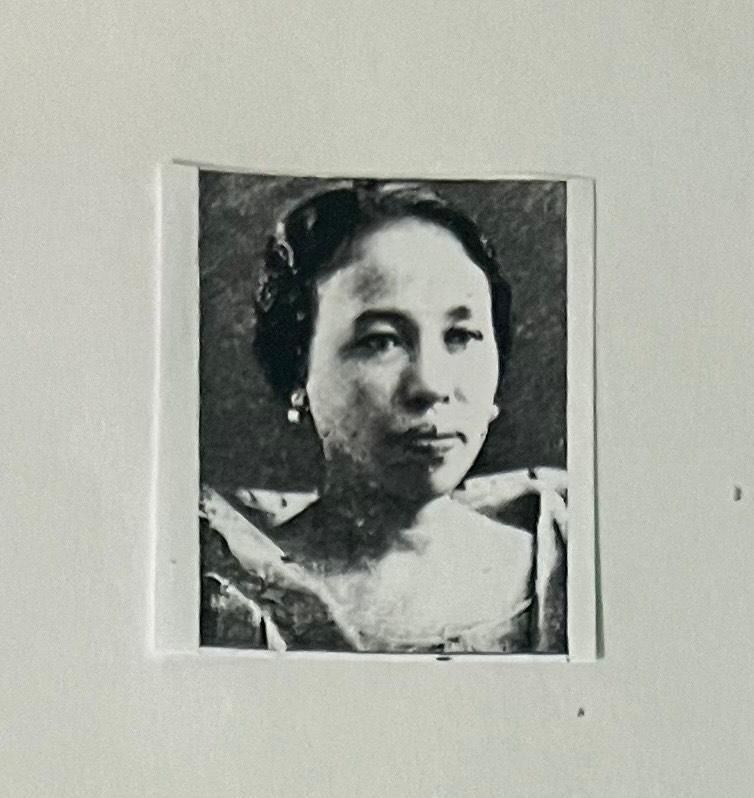
Ursula Uichanco-Clemente
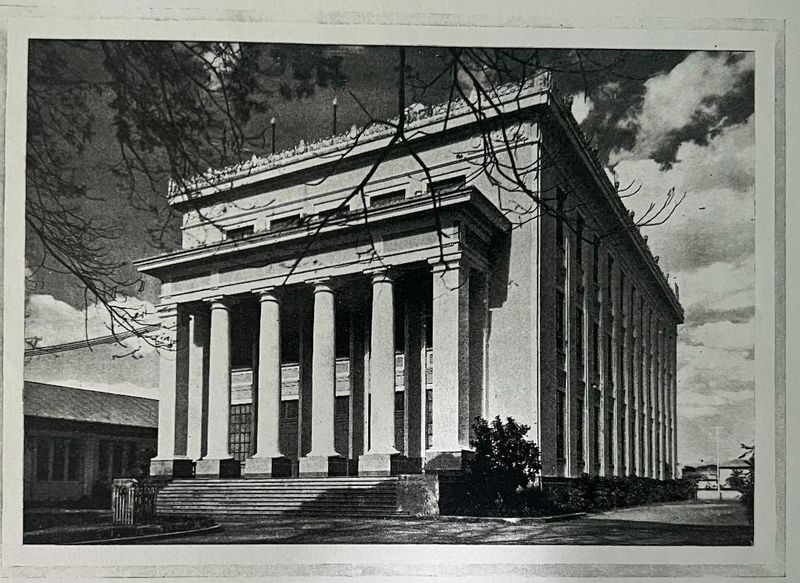
The College of Engineering Building
The ladies and gentlemen who went to the monthly socials had to be properly dressed for the occasion. When the gathering was on an important occasion, they had to be dressed to the nines.
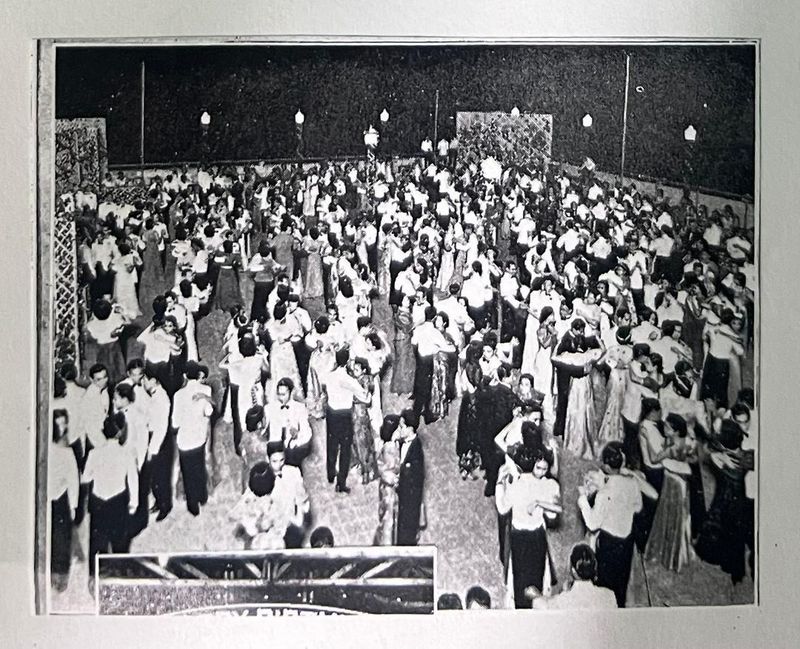
One of the monthly socials organized by Dean Clemente
A portable RCA Victor phonograph10 provided the dance music. Dean Clemente saw to it that the gentlemen remained gentle by keeping an appropriate distance from the ladies they were dancing with. She always carried a yardstick which she sparingly uses to separate couples whom she sensed were getting too intimate for their own good.
“One foot away!” That was what Dean Clemente bellowed while using her yardstick (which is three feet long, and not just a foot) in putting more distance between many dance partners.
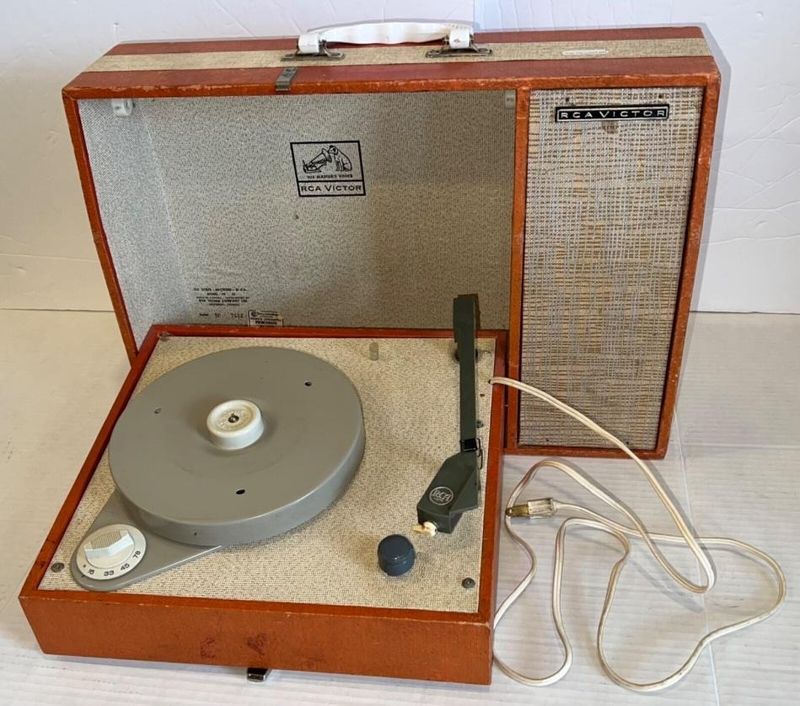
An RCA Victor phonograph
The dance music of the era consisted of Irving Berlin’s Cheek to Cheek, Cole Porter’s Begin the Beguine, and Jerome Kern’s The Way You Look Tonight. The popular dances were the waltz, the rumba and the foxtrot. Only the daring and the graceful danced the tango,11 often to Jalousie, La Cumparsita and La Paloma.
Dance time began at sundown and was over at exactly nine o’clock at night.12 It meant everyone had to leave the venue. That curfew made everybody cherish the last dance of the evening.

The Tango
The War and Its Aftermath
World War II in the Pacific broke out on December 7, 1941, and Manila fell to the Japanese invaders on January 1, 1942.13 As a consequence, Dean Clemente’s monthly socials were discontinued for the duration of the war.
Manila was liberated by American troops from Japanese occupation forces in March 1945, but the city was almost entirely destroyed. Even when the university reopened in August 1945, the campus was still too devastated to accommodate social activities. Inevitably, the monthly socials in UP Manila were to be no more.
Barn Dances
With the demise of the monthly socials in UP Manila, resident Upsilonians and Sigma Deltans longed for the return of Dean Clemente’s monthly socials. Thus, they organized regular private dance parties at the comfortable homes of the parents of fraternity or sorority members. The homes were located at the Ermita, Malate, San Miguel, and Paco districts of Manila, and in nearby Pasay City.
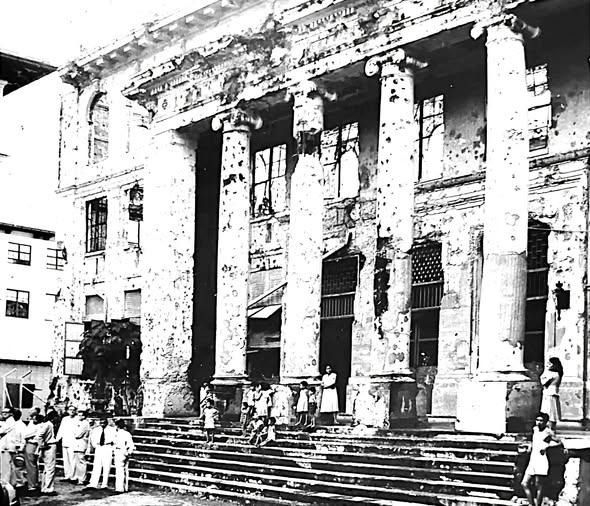
UP Manila August 1945
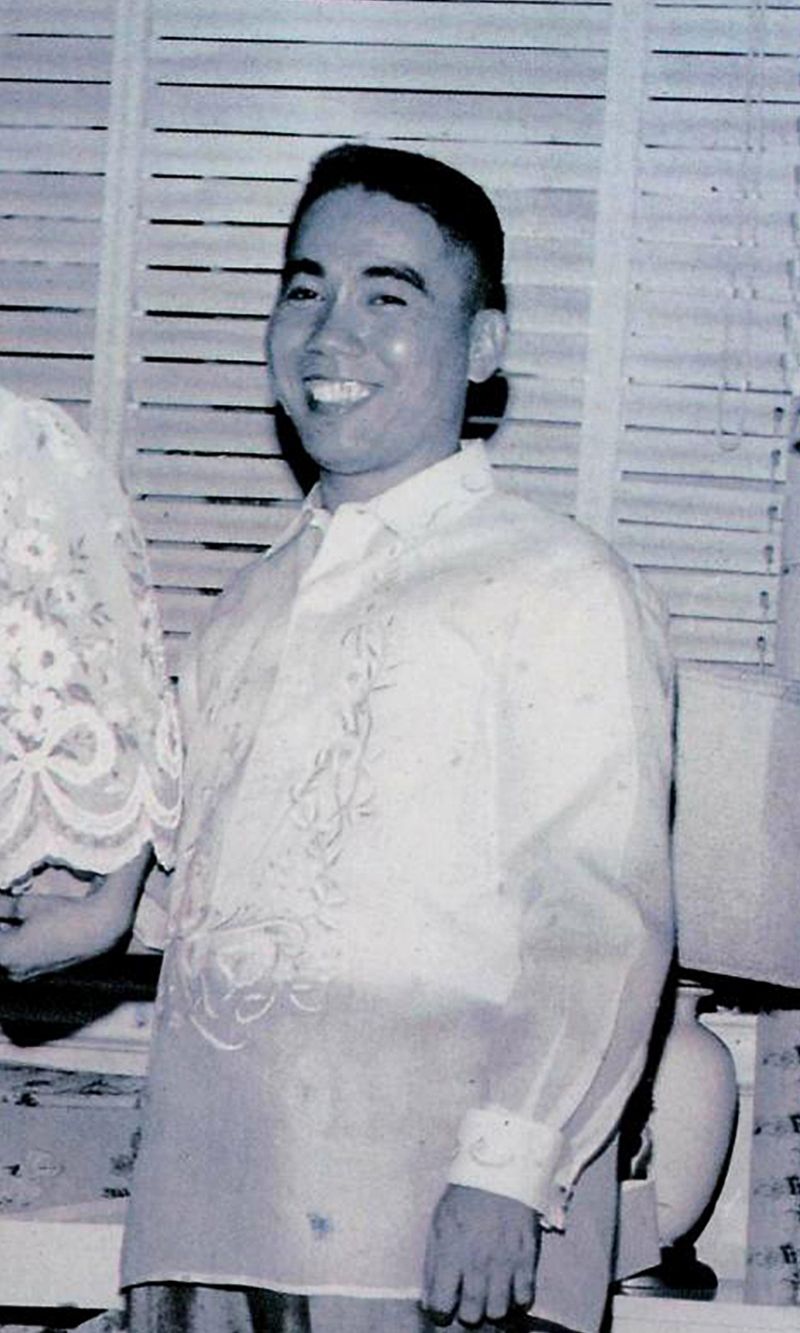
UP Fine Arts major Jose “Pitoy” Moreno (Batch 1948), the future Fashion Czar of Asia, was the point man in the organization of these parties.
Each of these gatherings was called a barn dance because there was plenty of clean hay all over the dance floor to give the occasion a rustic, informal ambience. All that hay was often acquired by resident Upsilonians from the San Lazaro Hippodrome located north of downtown Manila.
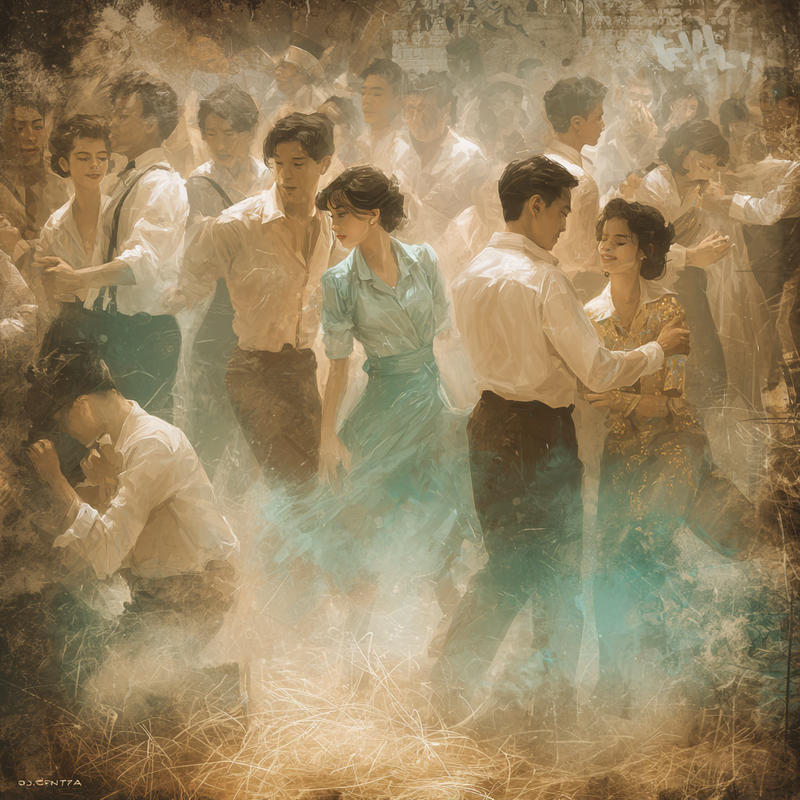
The barn dance was what it was supposed to be – a dance party with hay all over the place – but it also became an occasion for competitive singing and dancing by the brods and the sisters, and for the Upsilonians to serenade the Sigma Deltans.
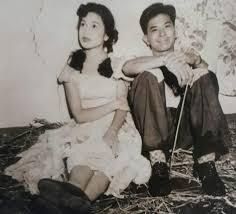
Sigma Deltan Celia Diaz and Upsilonian Salvador Laurel together at a barn dance
Many Upsilonians wooed their future spouses at these barn dances. It was at one of these barn dances where Salvador “Doy” Laurel (Batch 1947), who later became a senator (1967 to 1972), assemblyman (1978 to 1983), Secretary of Foreign Affairs (1986 to 1987), Prime Minister (1986) and Vice President (1986 to 1992), began courting Celia Diaz (Sigma Delta Phi Batch 1948), who eventually became his wife.14
Revival and Demise of the Monthly Socials
When the university completed the transfer of its flagship campus to Diliman in 1949, there were still no monthly socials there because the entire campus was virtually a wasteland. Except for the few Quonset huts15 left standing there by American soldiers before the war, the whole area was a vast, rolling terrain of wild grass, tropical flowers and shrubs, and small patches of quicksand. There were many venomous snakes in the area as well.
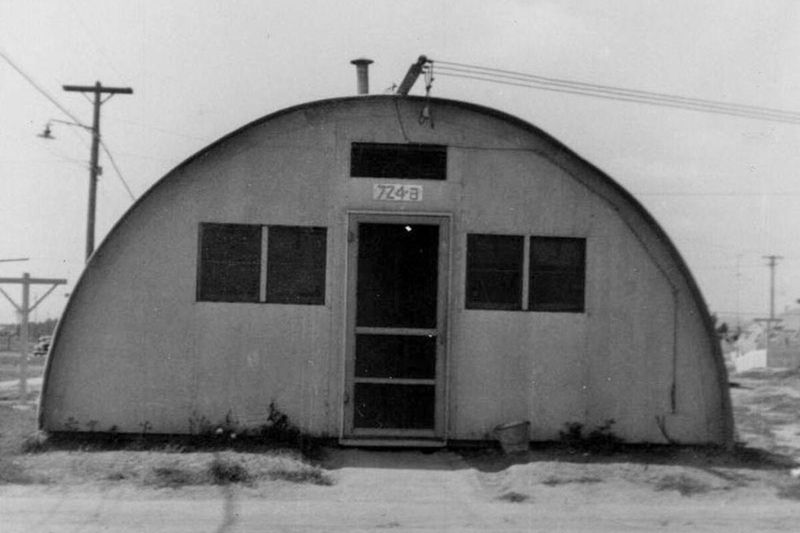
An example of a Quonset hut
In due time, new office buildings were constructed. Housing units were also put up for university officials and faculty members in several areas of the campus, and they went by the names “Area 1” and so forth.
UP Diliman at that time was inaccessible to students who needed to commute. Students residing in distant provinces found it nearly impossible to find housing accommodations on campus. Although some of the existing housing units there admitted boarders, housing remained a problem for many.
To solve the housing problem, several dormitories were constructed inside the campus. The most famous of these facilities was the South Dormitory, which was later named the Narra Residence Hall. Many Upsilonians resided in this dormitory during their college years. By the end of the first decade of the twenty-first century, this dormitory was demolished to give way for new school and office buildings.
One large Quonset hut left by the American military in Diliman was expanded and converted to a student social center, and later called the Gregory Terrace.16 It had enough space for dining facilities and social functions.
When Dean Clemente revived the monthly socials in the early 1950s, she chose the Gregory Terrace for the venue. Unfortunately, the monthly socials were discontinued after Clemente retired from the university during the third quarter of that decade.
Postwar Barn Dances
The demise of Dean Clemente’s monthly socials did not spell the end of the barn dance parties of the resident Upsilonians and Sigma Deltans in Diliman. These parties continued every so often, and were held at the homes of the brods and the sisters big enough for large gatherings. The venues were often held in the quaint residential areas in Manila and Pasay City, and on some occasions, in the new residential enclaves in Makati, San Juan, and Quezon City.
Because the barn dances were big parties, often with many hired musicians in tow, each individual who attended these affairs had to contribute a rather big sum of money to defray his or her share of the expenses for the event.
Toward the end of the 1950s, several resident Upsilonians and Sigma Deltans noticed that several brods and sisters residing in dormitories and boarding houses in the Diliman campus refrained from joining the barn dances. This was because of the strict curfew imposed by the dormitory managers and the owners of boarding houses. In particular, the curfew was strictly enforced on female dormers or boarders.
It was also discovered that many of the brods and sisters who came from the provinces were living on tight budgets, which would be further strained if they spent money on the barn dances. More often than not, their allowances did not include a budget for lavish social activities.
The Hobo Dance is Born
Naturally, the habitués of the barn dances were disheartened to learn that some brods and sisters could not join their merrymaking due to strict campus housing rules and financial constraints.
So that no Upsilonian or Sigma Deltan will find himself or herself outside of future barn dances just because of those restrictions, a solution to this concern was eventually found.
The barn dance habitués resolved to accommodate in their own homes for a night or two the Upsilonians and Sigma Deltans who are unable to return to their dormitories or boarding houses before the curfew. Thereafter, brods and sisters with vehicles at their disposal will transport the dormers and the boarders back to their respective places of abode, safe and sound. Of course, the usual arrangements with the dormitory heads and the owners of the boarding houses were made and processed earlier.
It was also resolved that Upsilonians and Sigma Deltans who can afford more than their share of the expenses will contribute a bigger amount to defray expenses, so that those who have limited means can join the barn dance. In short, the money needed for the barn dance was solicited from wealthy sponsors from among the brods and sisters long before the barn dance itself was actually held.
The entire arrangement was likened to the life of a hobo, i.e., a homeless person in the American countryside who commutes by hitching rides on freight trains. A hobo is able to survive daily life and experience simple joys without spending any money, and can easily find temporary accommodation at just about anywhere.
Withal, the barn dance came to be called a hobo dance or simply a hobo. To add a realistic dimension to the new name of the fraternity-sorority gathering, the Upsilonians and Sigma Deltans attending the hobo are expected to show up in tattered clothes. In many of the dances, the brods or sisters who show up looking like real hobos win special prizes donated by sponsors.
Because hobos usually have their makeshift “parties” inside a barn, the hay obiquitously found in the barn dances of old remained an important part in the ambience of the hobo dance; and because some merriment is expected in those “parties,” the singing, dancing, eating and drinking which characterize the barn dances are still integral to the hobo dance.
Evolution
The hobo dances of the late 1950s and the 1960s eventually evolved into a wholesome competition in song and dance numbers between the Upsilonians and the Sigma Deltans held at least once a year. The brods and the sisters separately rehearsed their respective numbers.
It also became a tradition that an Upsilonian and a Sigma Deltan have a joint performance as a symbolic gesture of “reconciliation” after an evening full of keen competition.
Some distinguished alumni from the fraternity and the sorority were invited to many of the dances.
Through the years, however, the sporting of tattered clothes at the hobo dance was discontinued for practical reasons, and the hay was no longer indispensable to the gathering. The hippodrome was simply too far away. Be that as it may, the competitive singing and dancing remained. So did the drinking and the dining that went with the event.
The Hobo Dance on Hold
By the early 1970s, the social environment in UP Diliman had changed. The penchant for cultural activities had taken a backseat to the growing student activism noticeable on campus. Nonetheless, the resident Upsilonians and Sigma Deltans continued the annual hobo dance tradition.
When President Ferdinand Marcos (Batch 1937) placed the entire country under martial law in September 1972, an authoritarian government was set in motion in the country, with the military establishment enforcing strict rules and regulations. Parties had to adjust to a nationwide curfew17 that made many an evening gathering end too soon for Upsilonians and Sigma Deltans.
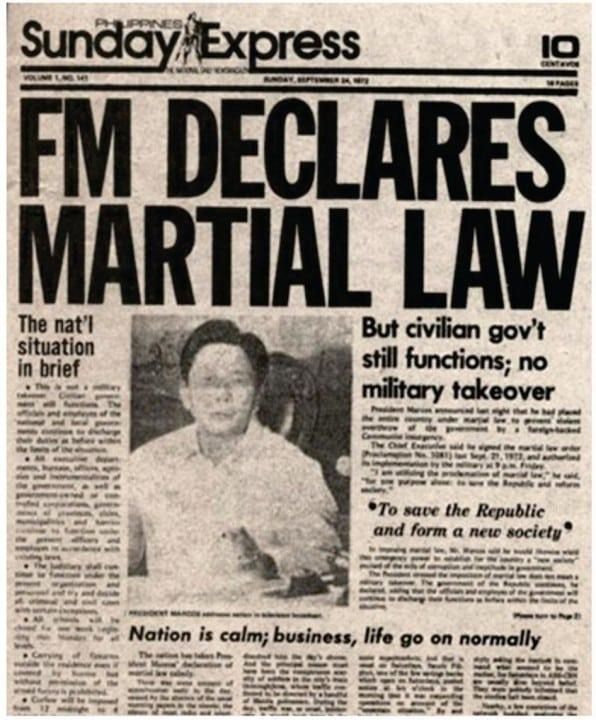
By 1975, the resident Upsilonians no longer took the competition aspect of the hobo dance seriously. They were more interested in the boozing and related undertakings that came with the activity. It was a precursor of things to come.
An incident in the hobo dance of 1975 put an abrupt end to the annual tradition. The resident Sigma Deltans, tired of the lack of serious preparations on the part of the resident Upsilonians, heckled the brods in the course of the event by making fun of the fraternity seal. Some Upsilonians responded with a brief, playful gesture that was unfortunately taken as a serious confrontation. The sisters took offense and walked out of the activity. Thus, for the next several years thereafter, the hobo dance tradition was on hold.
A Time for Healing
In 1979, the rift between resident Upsilonians and Sigma Deltans was still evident but had been mitigated by the passage of time. Unlike a few years earlier, at least they were now on talking and smiling terms with each other, particularly at the Palma Hall basement canteen, the traditional hangout of the brods and the sisters.
Some members of Batch 1979 of the Upsilon Sigma Phi wanted to meet and befriend their counterparts in the sorority. They were also interested in continuing the hobo dance tradition they heard so much about from the other fellows. After some initial hesitation on their part, the Sigma Deltans eventually consented to a meeting.
In September 1979, a meeting of the brods and the sisters from Batch 197918 took place at the Skipper’s Restaurant19 along Visayas Avenue in Quezon City. It almost seemed like a regimented supper, with the Upsilonians occupying one side of a long table, and the Sigma Deltans on the other side of the same. Pleasantries and handshakes were exchanged over a satisfactory meal. The meeting ended with an agreement to continue the goodwill established, and to explore the possibility of reviving the hobo dance tradition on some future, unspecified date.
Later that same year, the Sigma Deltans from Batch 1979 met anew with a number of their counterparts in the fraternity at a late Sunday afternoon soirée held at the home of a sister located at the Wack-Wack village in Mandaluyong. A few parlor games were played, and this led to warmer ties between the two groups. It was a prelude to a more serious dialogue between the residents of the fraternity and the sorority.
During the ensuing period, the resident Sigma Deltans expressed their reservations about reviving the hobo dance tradition, for fear that the fellows would misbehave as they did in 1975. In response, the resident Upsilonians told the sisters not to worry. The brods assured them that all would be in good order. It was also suggested by the fellows that a number of alumnae of the sorority attend the revival event as special guests.
After much stocktaking, the Sigma Deltans agreed.
Finally, in the summer of 1982, the resident Upsilonians and Sigma Deltans held the revival hobo dance at the stately home of Mariano Tolentino (Batch 1980) at La Vista Subdivision along Katipunan Avenue in Quezon City. Three alumnae Sigma Deltans, namely, banker Ligaya Lualhati-Tankeh (Batch 1950), artist Editha “Nenet” Lazo-Arambulo (Batch 1953), and Salvacion “Sally” Zaldivar-Perez (Batch 1953), who later became the Governor of Antique Province, joined the gathering as guests of honor.
The resident brods and sisters performed their respective musical numbers. One resident Sigma Deltan’s pantomime rendition of You Light Up My Life 20 to a live piano accompaniment by another resident sister elicited extensive applause, amidst hugs from the sisters present.
Right after the performances ended, the guests of honor expressed their satisfaction and pleasure with what they saw and listened to. They told everybody, “The alumni will organize a big revival of the hobo dance as soon as possible.” On that happy note, it was certain that the erstwhile rift was over at last, and that the hobo dance tradition was no longer to remain lingering in the freezer.
The Big Revival
As promised by the Sigma Delta Phi alumnae, they took steps to revive the hobo dance tradition by coordinating with alumni fellows of the Upsilon Sigma Phi.
Thus, on one evening in 1983, alumni and resident Upsilonians and Sigma Deltans held their biggest ever hobo dance. The venue was the palatial home of former Senator Maria Kalaw-Katigbak, a charter member of the sorority,21 located at the western corner of Aurora Boulevard and Gilmore Avenue in New Manila, Quezon City, right across the Saint Paul College campus.
A few days before the event, Sigma Deltan Lily Lim (Batch 1972) of the Philippines Daily Express22 publicized the hobo dance in her regular social column under the title Have a Hobo. In that piece, Lim reiterated that there will be no entrance fees for the event. She wrote, “hobos are not supposed to have any money.”
Funds for the hobo dance were pre-solicited from generous alumni Upsilonians and Sigma Deltans. Thus, and as Lim had announced earlier, those who went to the affair were not required to pay anything.
The food consisted of a roasted calf, plenty of lechon, an endless array of fried chicken and pork barbecue, lots of pasta, and seemingly endless servings of macaroni and fruit salad. Soda was all over the place. Boozers were extremely delighted with the San Miguel draft beer overflowing from several aluminum barrels. Premium liquor was plentiful.
Clean hay fresh from the San Lazaro Hippodrome was all over the huge dance floor. Resident brods Romero Yu and Jose Villareal (both from Batch 1981) acquired the hay earlier in the morning of that same day.
Editha Lazo-Arambulo (Batch 1953) was the master of ceremonies. She was assisted by another Sigma Deltan, professional stage actress Joy Gamboa-Virata (Batch 1953) of Repertory Philippines.
Separate musical performances by Upsilonians and Sigma Deltans began right after the first round of food was served. The numbers, although seemingly rendered in an atmosphere of competition, were all done in the spirit of wholesome fun.
A professional pianist23 provided the music. He could play practically any piece requested by the guests. If he did not know a particular piece, there was a large suitcase of minus-one compact cassettes, brought by the Sigma Deltans, from which singers can choose and sing along with. In short, there was no excuse not to sing.
Resident fellow Ernesto “Cochise” Bernabe II (Batch 1981) serenaded the audience with his lovely rendition of Never Ever Say Goodbye.
Nobody, regardless of seniority, was allowed to leave the hobo dance earlier than ten in the evening. Those who really needed to leave were allowed by the master of ceremonies to do so, but only after rendering a song. Upsilon Sigma Phi Alumni Association President Ponciano Mathay (Batch 1948) had to sing Tanging Diyos Lamang ang Nakakaalam before he was allowed to leave before 10 PM.
Resident Sigma Deltans sold nice yellow sorority t-shirts with black textile at the edges. Ernesto Salazar Jr. (Batch 1982) bought a lot of the shirts.
An estimated 200 attended the hobo dance.
The 1983 hobo dance was a big success. It was a revival of a tradition, but this time, nobody was required or showed up in hobo attire.
Subsequent Hobo Dances
The success of the 1983 hobo dance led to many a reprise of the event among resident Upsilonians and Sigma Deltans, albeit on a smaller scale.
In December 1984, the resident Upsilonians led by law student Rodolfo “Inky” Reyes (Batch 1978) organized a hobo dance with the resident Sigma Deltans at the majestic Antipolo residence of engineer Donato Pangilinan (Batch 1951) located at Barangay Mayamot along the Sumulong Highway.24
The revival of the hobo dance was short-lived. In the years that followed, the resident Upsilonians and Sigma Deltans decided to have Christmas parties, without the elaborate preparations needed for hobo dances. The yuletide gatherings proved to be more economical and less cumbersome to organize.
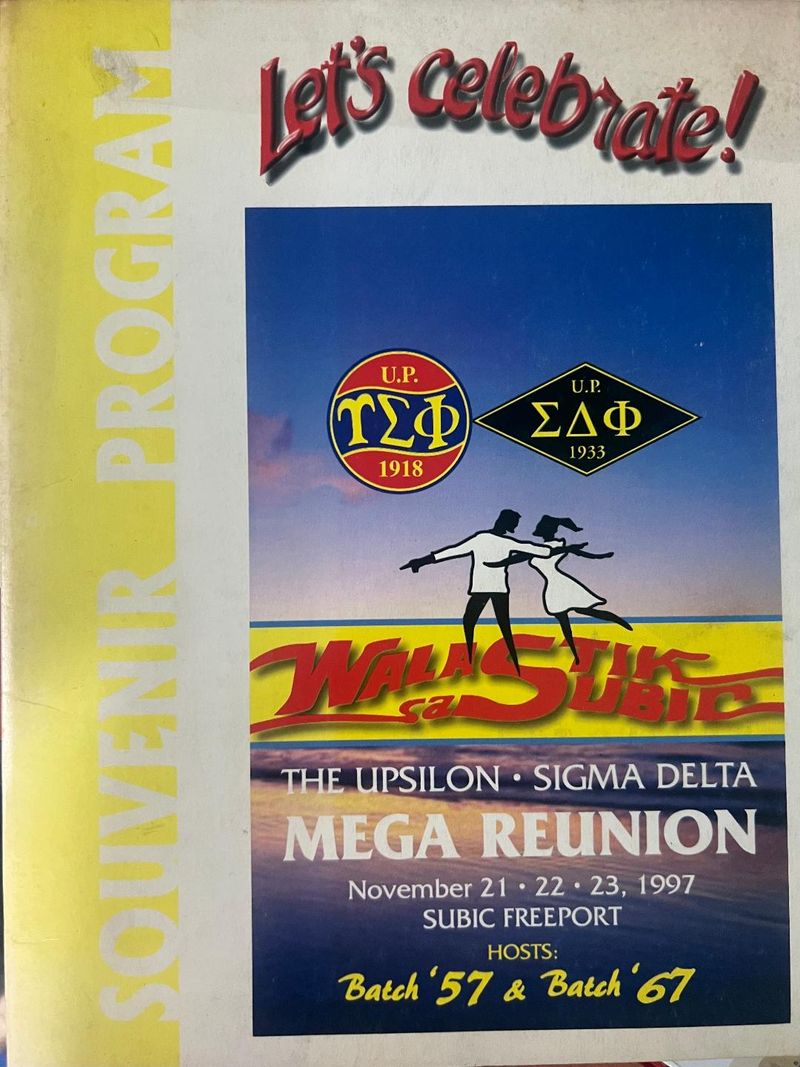
Walastik sa Subic 1997
On November 21, 1997, Batches 1957 and 1967 of the Upsilon Sigma Phi and Sigma Delta Phi celebrated their fortieth and thirtieth anniversaries, respectively, at Walastik sa Subic held at the Subic Bay Free Port in Zambales. This overnight activity was dubbed a “mega reunion” by the organizers.25 An estimated 200 alumni and resident Upsilonians and Sigma Deltans attended the affair.26 The spouses of a few Upsilonians came along, too.
A hobo dance marked the evening festivities, with alumni and resident Upsilonians and Sigma Deltans competing in a number of song and dance numbers.
The only “downside” to the activity was the mandatory laceration of a part of the shirt or blouse of all the brods and the sisters, apparently to make each one of them “look like” a hobo.27 Many, particularly those who sported very nice, expensive clothing, were terribly upset with this part of the activity.28
Other Hobo Dances
A few more hobo dances were held in the years following Walastik sa Subic. 28 The attendance in both was rather minimal, apparently because the laceration of shirts is something that does not sit well with many Upsilonians and Sigma Deltans. Since then, the hobo dance was again discontinued and in lieu of the same, an annual Christmas party was jointly held by the fraternity and the sorority at the Ang Bahay ng Alumni in Diliman.
Prospects
Withal, some Upsilonians and Sigma Deltans ask if the hobo dance tradition should continue. Perhaps a clue to the answer to that may be found in nearly every participant’s dislike for the needless ripping of upper garments at a time when fashionable, quality clothing comes at a very dear price.
A more hopeful prognosis, however, is that by reviving the hobo dance tradition this year, contemporary Upsilonians and Sigma Deltans will be able to relish it enough to make it a continuing institution in the fraternity and the sorority for generations to come.
If history is a reliable portal for predicting the future, and it has all the badges that it is, then celebrating the hobo dance tradition every year will allow all brods and sisters to cherish, with the same degree of enthusiasm as the forebears did during their own wonderful time, what is arguably a unique and charming way of living life as members of the greatest brotherhood and sisterhood ever organized in the University of the Philippines.
Endnotes:
1 Cabaret is pronounced kah-buh-RAY. The cabaret originated from France and became very popular in Paris.
2 By the 1950s, the cabarets in Manila came to be associated with prostitution and bar room brawls.
3 Roberto Villar, Sta. Ana Cabaret, Where Manila’s Rich and Famous Partied ‘Til They Dropped, ESQUIRE (PHILIPPINES), January 2, 2020.
4 A taxi dancer is dance partner who is paid for dancing practice in either a cabaret or dance studio, or as a dance partner in a party. The taxi dancer is paid for each dance. Almost all taxi dancers of the period were respectable young women who needed the part time employment to finance their college education.
5 James Lindenberg, an American in the Philippine Islands in the post-war period, obtained a legislative franchise to put up the first television station in the Philippines, but he was unable to go on the air because of insufficient capital. Eventually, Quirino acquired Lindenberg’s non-operating business and established the Alto Broadcasting System (the predecessor of the ABS-CBN broadcasting network), the first television station in the country.)
6 Aleli Guzman-Quirino was the first fraternity sweetheart of the Upsilon Sigma Phi.
7 Yes, there was such an item in the UP bureaucracy back then. The Dean of Women was responsible for the physical safety, morality and well-being of all female students in UP Manila.
8 Prior to World War II, the leading toothpaste (or dental cream as it was then called) of the period was Kolynos. Students of the period jokingly referred to Dean Clemente as the Kolynos Girl, owing to her wide smile, as well as her conspicuous gums and dentures. Dean Clemente was instrumental in the creation of the Sigma Delta Phi as early as 1931, although the sorority was recognized by the university only in 1933. Clemente taught Euthenics – the study of improving human life through better living conditions.
9 The College of Engineering in UP Manila is now the main building of the Court of Appeals. After the war, the roof deck of the building was converted to a fourth floor. Florida Street, which marked the western border of the quadrangle of the university campus, was renamed Maria Y. Orosa Street after World War II. Orosa, a chemist, was a heroine of the war and the inventor of the banana catsup.
10 The RCA (Radio Corporation of America) Victor phonograph is a device which played vinyl records. During that period, the vinyl records were played at 78 revolutions per minute using a stylus.
11 The tango has been dubbed as the most elegant dance in the world, BRISBANE HOUSE OF TANGO WEBSITE, September 23, 2024, https://brisbanehouseoftango.com.au.
12 Back then, Ermita and Malate were residential districts. The streets were practically deserted after dusk.
13 December 8, 1941 and January 2, 1942, Manila time.
14 Nick M. Joaquin, DOY LAUREL IN PROFILE, Third Edition, LAHI, Inc., Makati, Philippines, page 157 and 158.
15 A Quonset hut is a prefabricated building made of corrugated galvanized iron sheets with a semi-circular shape that combines the roof and walls into one continuous structure. It was very hot and uncomfortable inside a Quonset hut during the daylight hours.
16 The Gregory Terrace was located at the east side of the Diliman campus near the UP College of Law. It was eventually demolished as newer buildings were erected on the campus.
17 The curfew forced Upsilonians to go home early every night. During the first months of martial law, the nationwide curfew ran from 12 midnight to 4 o’clock in the morning. By 1973, the curfew was reduced to from 1 to 4 o’clock in the morning. In 1977, President Marcos lifted the curfew for good.
18 Agnes Pangilinan led the sorority’s delegation. Ramon Francisco and Victor Avecilla were among the Upsilonians present.
19 Skipper’s Restaurant, which had a maritime ambience, closed shop in the early 1980s. Its site is now a structure to the left of the Petron gasoline station near the corner of Visayas Avenue and Lands Street.
20 You Light Up My Life was written by Joe Brooks and was the song in the 1977 Hollywood motion picture of the same title. The piece, performed by Debbie Boone, won the Academy Award for Best Original Song.
21 After her term in the Senate, Maria Kalaw-Katigbak served as the Chairman of the Board of Review for Motion Pictures and Television, the agency that regulated film exhibitions and television broadcasts in the country, and the precursor of the current Movie and Television Review and Classification Board. The Katigbak residence had a big outdoor dance floor and party area that can easily accommodate a hundred guests at any one time. Several shade trees adorned the venue. A building stands in its place today.
22 The PHILIPPINES DAILY EXPRESS, a daily newspaper of general circulation operating in Intramuros in Manila, was owned by Ambassador Roberto S. Benedicto (Batch 1936). Its chief editor was Fellow Enrique Romualdez (Batch 1947). Another Upsilonian, Rolando Fernandez (Batch 1970), was also an editor of the newspaper. Founded in May 1972, this newspaper began as a tabloid but eventually became a broadsheet. It stopped publication in 1987.
23 The pianist, Virginio Martinez, regularly worked at the Club Filipino in San Juan. Lawyer Ramon Maronilla (Batch 1966) contracted his services for that evening.
24 The stars of the evening event were Jose Ramos Jr. (Batch 1980), Rosario “Rosanna” Henares (Batch 1983) and Isabel Buencamino (Batch 1984) Spoof renditions of songs like My Sharona and Superstar (from Jesus Christ Superstar) were performed during the hobo dance.
25 A solemn seaside prayer was recited by Dr. Alfredo Ramirez (Batch 1957), banker Edgardo Espiritu (Batch 1955) was given the Upsilon Millenium Award, and copies of THE UPSILON SUN (then edited by Victor Avecilla [Batch 1979]) were distributed free to the participants. Richard Gordon (Batch 1968), Chairman and Administrator of the Subic Bay Metropolitan Authority, and his wife Katherine Gordon welcomed the participants.
26 Some of the Upsilonians who were there include Felipe Sese (Batch 1953), Regulo Quitoriano and Christian Monsod (both from Batch 1955), Victor Puyat and Eliseo Ilano (both from Batch 1957), Blamar Gonzales (Batch 1966), Eduardo Zialcita (Batch 1968), Wilfredo Fernandez (Batch 1969), Rainier Almazan (Batch 1976), Rodolfo Reyes (Batch 1978), Victor Avecilla and Eduardo Espina (both from Batch 1979), Romero Yu and Ramon Alikpala (both from Batch 1981), Gerard Estrella (Batch 1985), Noel Damot (Batch 1993), and Marco Abesamis and Gino Castañeda (both from Batch 1996). Sigma Delta alumnae Salvacion Perez (Batch 1953) and Solita Collas-Monsod (Batch 1956) were among the many members of the sorority who graced the occasion. Katherine Gordon joined the Sigma Deltans in singing the sorority song at the Subic Bay beach.
27 Eliseo Ilano (Batch 1957) was in charge of the cutting of the shirts.
28 Christian Monsod and Eduardo Zialcita were terribly upset that their expensive shirts were destroyed.
29 One was held in December 2014 at Tiago Restaurant along Scout Fuentebella Street in Quezon City, and another at the Ang Bahay ng Alumni in UP Diliman.
About the Author
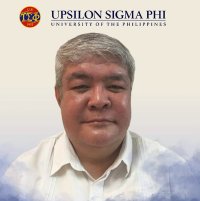
Victor C. Avecilla '79
Victor C. Avecilla ’79 is a lawyer, former Presiding Commissioner of the Third Division of the National Labor Relations Commission, and a longtime broadcast communication professor at the UP Diliman College of Mass Communication. He has written widely on law, public affairs, and fraternity history for publications such as the Daily Tribune and The Upsilon Sun.